
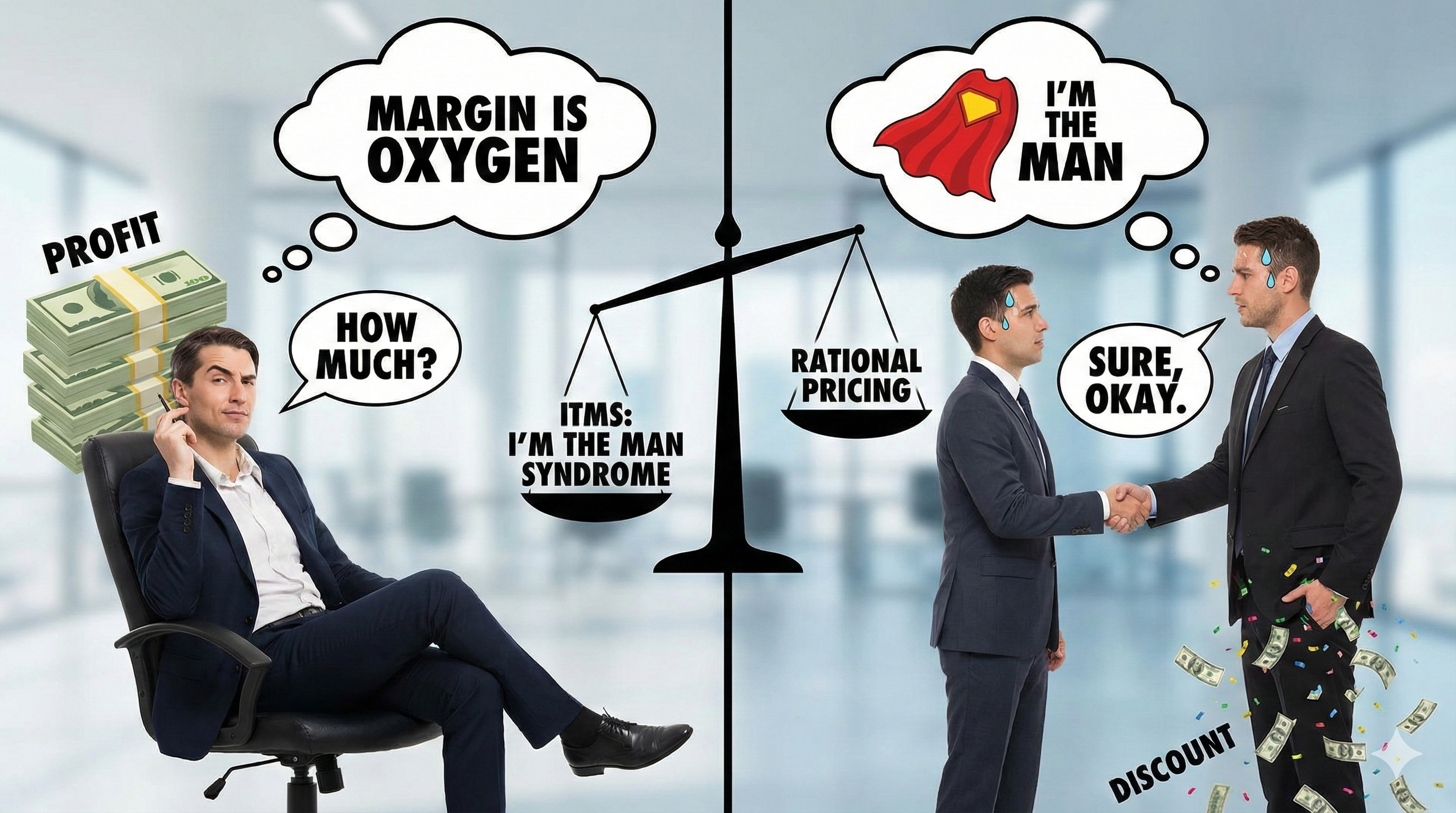
When a business owner tells you the price of their product or service, try this:
Lean back slightly. Raise an eyebrow. Say two words:
“How much?”
The power of “How Much?”
That’s it. No spreadsheet. No debate. No TED Talk. Just tone.
You’d be amazed how often someone with full pricing authority immediately offers a better second price — without you saying another word. It’s the cheapest negotiation tactic on earth. Costs nothing. Pays often.
Try it three times this week. Don’t argue with me — test it.
Here’s another uncomfortable truth:
If you give salespeople 10% discount authority, most of them will discount nearly every deal by 10%.
Not because the customer demanded it.
Not because the deal required it.
Because they can.
Why? Ego + urgency + the emotional need to win and be liked — a dangerous cocktail served neat in the heat of a deal.
And founders do this too. Especially founders. You’re not immune — you’re usually worse.
Let’s talk about why.
Sales, Discounts & Ego — Meet the Caveman
Early in my career selling enterprise software, we had a VP of Sales we called The Caveman.
He thought it was because he was a fierce negotiator.
It wasn’t.
Over the phone, he never approved discounts. Granite wall. Absolute no.
But get him in the room, in front of the customer, with his chest puffed out and his closer-swagger engaged — and suddenly discounts fell from the sky like confetti.
He didn’t hold the line.
He caved in the cave.
Thus: Caveman.
Put authority + ego + audience together and margin mysteriously evaporates.
This is not a sales problem. This is a human problem.
The Pricing Disease: “I’m The Man Syndrome” (ITMS)
I call this I’m The Man Syndrome — ITMS.
Symptoms include:
-
“I’ll just shave a little off to get it done”
-
“We’ll make it up on volume” (you won’t)
-
“This one’s strategic” (they’re all strategic)
-
“It’s only this once” (it never is)
Founders are especially vulnerable because — let’s be honest — you didn’t start a company because you love rules and process. You started it because you hate them.
Unfortunately, margin loves rules.
A Story About Smart Sons and Dumb Authority
I once read about a coat manufacturer split into two divisions: father ran one, sons ran the other.
The sons’ division was significantly more profitable.
Why?
The sons needed Dad’s approval to discount. Dad needed no one’s approval to discount his own prices.
Constraint beat freedom. Process beat impulse. Margin beat ego.
Let that one sink in.
How to Stop Yourself From Lighting Profit on Fire
You need guardrails — not because you’re weak, but because you’re human.
1️⃣ Emotionality Insulator
Decide discount rules before the deal, not during the adrenaline rush.
Pre-commit. Write it down. Follow it.
If your team needs guidelines, so do you.
2️⃣ Heat-of-Battle Defuser
When you want to break your own rule, invoke a fake higher authority if necessary:
-
“I need board approval”
-
“Finance has to sign off”
-
“My partner reviews exceptions”
-
“My dog is very strict on margins”
You’re not stalling — you’re cooling off your lizard brain.
3️⃣ Accountability Partner
Have a margin buddy. Another founder. Advisor. Spouse. Anyone rational.
Run exception deals past them before you swing the axe.
If your pricing strategy is reviewed only by the same emotional person making the deal — you — that’s not governance. That’s improv comedy.
Why Committees Often Beat Cowboys
Venture capital firms make pricing and valuation decisions by committee. That’s one reason their valuations are often more conservative than angel investors.
Committees use formulas. Models. Assumptions. Debate.
Angels often use gut feel, excitement, and the powerful investing metric known as Vibes.
Founders negotiating alone often use an even worse model:
Hope + Ego ÷ Urgency
Bad math.
Bottom Line
If you’re a shareholder — and I hope you are — your job is to protect margin like it’s oxygen.
Because it is.
Discounting emotionally feels generous, decisive, and heroic in the moment.
It’s usually none of those things.
It’s just expensive.
And the two most dangerous words in pricing are not “too high.”
They’re:
“Sure, okay.”
