
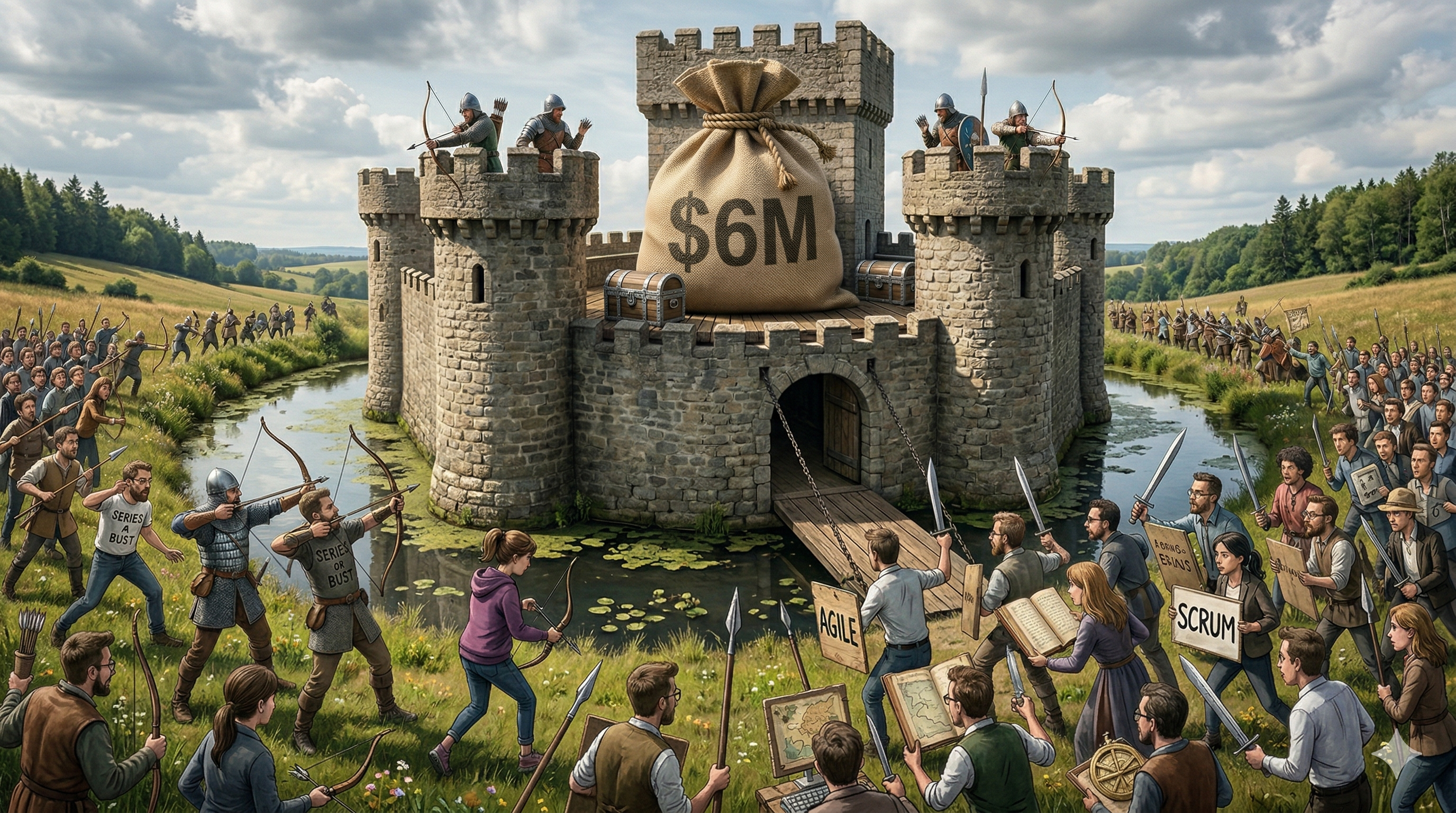
Here’s a story two generations of founders tell themselves, and only one of them is true.
Generation One: “We need to find a VC.” Translation: We need capital to exist at all.
Generation Two: “We need to find a VC.” Translation: We need validation that we’ve already figured this out.
Same sentence. Completely different universe.
The World That Was
Cast your mind back thirty years. No internet. No AWS. No Upwork. No offshore dev shops in Bangalore answering Slack messages at 2 a.m. If you wanted to build enterprise software, you weren’t building software — you were building versions. One for IBM. One for Digital Equipment Corporation. One for Data General. One for Sun. One for Pyramid. Each with its own operating system, its own quirks, its own way of telling you that your code was garbage.
The cost to start a technology company in 1990 was roughly $6 million in 1990 dollars. You needed hardware. You needed bodies in seats. You needed physical infrastructure before you wrote line one of production code.
That number wasn’t just a barrier to entry. It was a moat.
Because here’s what $6 million in venture capital also bought you, beyond the hardware and the headcount: a validated competitive position before you ever shipped a product. The VC ecosystem in any given niche had capacity for four, maybe five funded companies. If you were one of them, the market had already spoken. Competitors had to also raise $6 million from a different partner at a different firm who believed in a different thesis. The odds were structurally in your favor.
Venture capital in 1990 wasn’t just money. It was a permission slip. A velvet rope. A force multiplier that, by its very existence, created competitive advantage.
The World That Is
You can build a company today for $100,000. Maybe less. Probably less, if you’re clever and willing to eat ramen for a year.
Cloud infrastructure that would have cost millions in CapEx is now an Amex charge. A global talent pool — designers in Eastern Europe, engineers in Latin America, QA teams in Southeast Asia — is a Zoom call and a contract away. A single codebase runs everywhere. The platform wars are over. The internet won.
The democratization of company creation is genuinely miraculous. It is also, for founders, genuinely terrifying.
Because here’s the other side of that coin: if you can build a company for $100K, so can a thousand other people who had the same idea last Tuesday.
The moat is gone. The velvet rope is gone. The structural competitive advantage that came with simply surviving the fundraising process — gone.
Where there were once four or five funded competitors in a niche, today there can be hundreds of bootstrapped, lean, hungry operators coming at you from directions you haven’t mapped. A solo developer in São Paulo. A two-person team in Seoul. A product manager who left your company last March and built your roadmap in six months.
The barrier to market is no longer access to capital. The barrier to market is now proof that you deserve to exist.
VCs Moved the Goalpost — Because They Had To
This is where founders get hurt most: they’re still operating on the old mental model.
Thirty years ago, venture capital was risk capital. VCs took genuine technical risk, market risk, distribution risk — all simultaneously, often before any revenue existed. The bet was on the team, the thesis, and a spreadsheet full of TAM projections that nobody could validate until years later.
That model isn’t dead. But it’s been dramatically reweighted.
Today, venture capital functions primarily as growth capital. The question VCs are actually asking isn’t can this work? It’s has this already started working, and can we pour fuel on it?
The metrics they want aren’t theoretical. They’re not your projected LTV, your modeled COGS, or your assumed CAC built on market research and hope. They want traction. Real revenue. Actual unit economics that emerged from real customers making real purchasing decisions with real money. Proof of concept that came from the market, not a pitch deck.
Which means the seed round is no longer the starting gun. It’s more like the first qualifying lap.
What This Means for You
If you’re a founder approaching a VC with an idea and a deck, you’re not just late — you’re playing the wrong game.
The new sequence looks like this:
- Build something real for almost nothing. Use the tools available to you. Offshore what you can. Automate what you can automate. Get to a working product on a budget that would embarrass your 1990 counterpart.
- Get customers. Get revenue. Get data. Not because investors are greedy — because the market is your most credible validator. A customer paying you money is worth a thousand lines of TAM analysis.
- Understand your unit economics before you claim them. VCs have seen enough spreadsheets to know what “projected” means. They want to see LTV, CAC, payback period, and churn numbers that came from actual transactions, not assumptions in a financial model built in a weekend.
- Differentiate with specificity. Your thousand potential competitors are out there. “Better, faster, cheaper” is not a differentiation strategy — it’s an obituary written in advance. What do you know, or do, or serve, that they cannot easily replicate?
- Then go raise. With traction. With proof. With a story the market has already started telling on your behalf.
The Uncomfortable Truth
The old VC model rewarded access. The new one rewards execution.
That’s not worse. In many ways, it’s more honest — the market is a better judge of product-market fit than any partner meeting. But it requires founders to reframe the entire journey.
You are no longer pitching potential. You are presenting evidence.
The good news: the tools to gather that evidence have never been cheaper or more accessible.
The bad news: that’s true for everyone else, too.
So get moving.
Glen Hellman is a Distinguished Faculty member at the University of Maryland’s A. James Clark School of Engineering, where he runs NSF I-Corps programs for STEM researchers. He is also the founder of CxO Elevate, an executive coaching and CEO peer advisory firm. He has lived this story from both sides of the table.
