
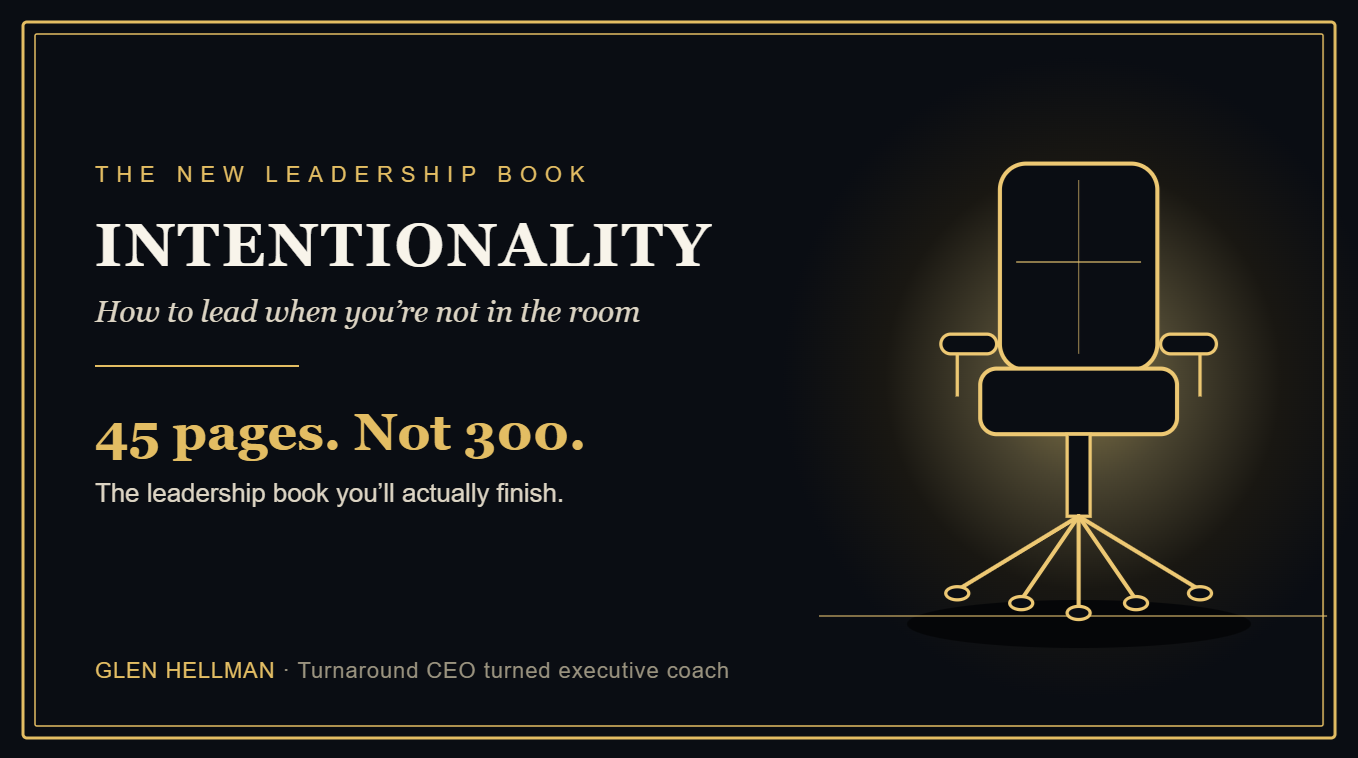
My New Leadership Book Is 45 Pages. You’ll Thank Me.
People keep picking up my new book, turning it over in their hands, and asking the same question with their entire face: is this the whole thing?
Yes. It’s 45 pages. That is not an abridgment, a sample, or a printing error. It’s the book. And before you decide you’ve been shortchanged, let me explain why 45 is the honest number and 300 would have been the lie.
Here is how the business-book sausage gets made. A publisher cannot charge thirty dollars for a pamphlet—the spine has to be thick enough to look serious on a shelf, thick enough to survive being held up in an airport bookstore by a guy who will never read past chapter two. So the author takes one genuinely good idea and stretches it like taffy across 300 pages. The idea arrives on page eleven. The remaining 289 pages are that same idea wearing different hats. Case studies. Sidebars. A four-page story about the author’s golden retriever that is somehow supposed to illustrate “resilience.” You have been there. You did not finish. That book is on your nightstand right now, a bookmark  fossilized at page 38.
Page count is not a measure of value. It’s a measure of price. Somewhere along the way we all quietly agreed that thick equals serious and thin equals lightweight, and that agreement has cost every reader in America about four hours per book of their one finite, non-refundable life.
Here’s the part nobody admits: short is harder. There’s a line usually pinned on Mark Twain—though it was almost certainly Pascal, because the good lines always get reassigned to whoever’s more famous—about apologizing for writing such a long letter, because he hadn’t had the time to write a short one. That’s the whole secret. Padding is easy. You just keep typing. Cutting is the labor. I wrote the 300-page version in my head, and then I spent the actual work deleting it. Every one of these 45 pages is here because it survived something.
So what you’re holding isn’t a short book. It’s a normal book with the packing material removed. Same idea, same stories, zero filler. The value-per-minute is frankly indecent, precisely because I did the boring part—the cutting—so you don’t have to do it yourself with a highlighter at eleven at night, hunting for the four sentences that mattered.
And here’s the other thing they never tell you about business books: they do not have to be a punishment. Mine has jokes. Real ones. It has stories about companies dying, and good people getting fired, and a CEO suite the size of a small embassy that I turned into the employee break room on my second day—and somehow it’s funny, because the truth usually is, if you’re willing to look at it straight on. A leadership book is allowed to be a good time. Fun is not the opposite of serious. Fun is how serious things actually get remembered.
Because the dirty secret of the entire genre is this: a brilliant book you abandon at page 40 delivers exactly zero value. A useful book you actually finish—on one flight, laughing in a couple of places you maybe shouldn’t—changes how you lead on Monday. Finishing is the whole game. So I built a book you’ll finish.
It’s about how to lead when you’re not in the room. How to become the kind of leader whose standards keep running the place long after you’ve walked out of it. That’s the idea. It’s worth knowing. And I promise to hand it to you in 45 pages, get out of your way, and let you go run something.
You’re welcome. Although, if you’d genuinely prefer, I can pad it back out to 300 and charge you triple. Just say the word.
You’ll thank me when you’re done. And you’ll be done months earlier than if you’d read the War and Peace version of the leadership manual.
